The Architecture of Fear and the Mechanics of Excellence: A Clinical Blueprint for Peak Padel Performance
Pressure doesn’t reveal your level—it reveals your system. Here’s the blueprint to engineer consistency in high-stakes padel.
3/19/20262 min read

For years, the sports world has relied on "empty motivational phrases" to fix performance gaps. However, at JF2 Academy, our multidisciplinary elite panel—comprising experts in physiology, cognitive neuroscience, and clinical psychiatry—has identified that performance is never an act of conscious willpower alone. It is a byproduct of your subconscious state.
Beyond Traditional Mental Training
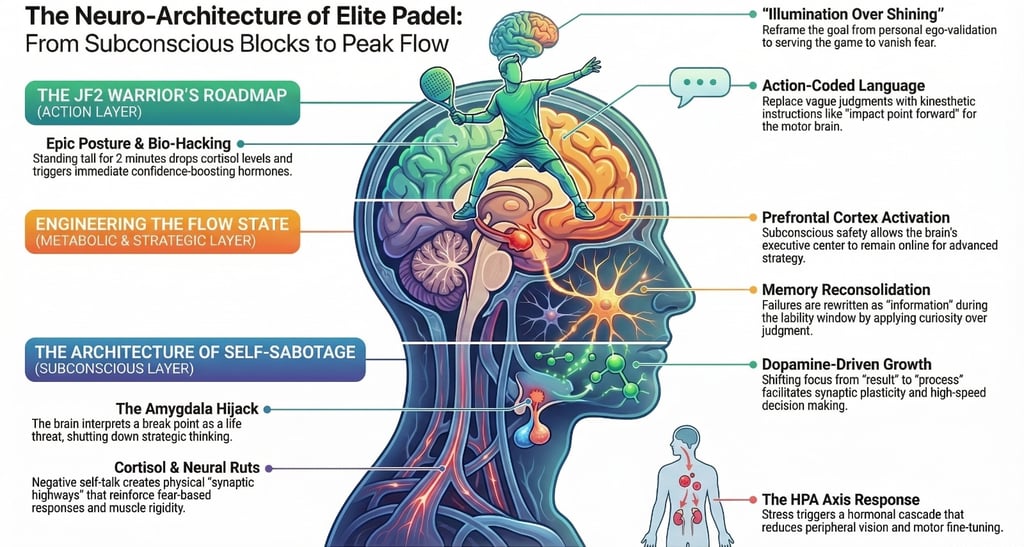
The Science of Self-Sabotage : The Amygdala and the Prefrontal Collapse
The human brain evolved for survival in the savanna, not for the nuances of a padel match. When the pressure mounts, the "Amygdala Hijack" occurs. The brain interprets a potential unforced error as a life threat, activating the HPA Axis and triggering a biological survival sequence.
As cortisol and glutamate (an excitatory neurotransmitter) flood the system, they fundamentally shut down the Dorsolateral Prefrontal Cortex. This is the "Prefrontal Collapse": logic, strategy, and creativity vanish, leaving the player with only primitive fight, flight, or freeze responses. This manifests physically as "stiff arms" and tactical collapse.
The Fallacy of Positive Thinking
Many players attempt to use "positive thinking" to bridge the gap during high-stress moments. Scientifically, this is a house of cards. If a player’s subconscious feels their human worth depends on winning the set, the Limbic System (survival brain) will permanently overpower the logical brain. True excellence requires Subconscious Psychological Safety, where an error is viewed strictly as "mechanical data" rather than an "indictment of identity".
The JF2 Methodology : Rewriting the Brain
Our approach focuses on Synaptic Rewriting. The adult brain is highly malleable, and through "focused curiosity," we can literally grow new dendritic spines.
The Lability Window: Immediately following an unforced error, there is a "window" where memory is unstable. By associating the failure with a mechanical solution and curiosity rather than judgment, we physically alter the memory trace in the hippocampus.
The Action Code: The motor brain cannot process adjectives or negative commands (e.g., "Don't miss"). We train athletes to use Kinesthetic Vectors—spatial coordinates like "Lower center of gravity"—which facilitate elite motor execution.
Mastering the Pause: We view the time between points as a mechanical opportunity. Respiratory control is used as a precise lever to send a chemical signal to the hypothalamus, confirming the organism is safe and preventing the Amygdala from initiating a hijack.
The Conscious Warrior
Peak performance is the inevitable destination of a mind that has stopped fighting itself. By shifting focus from the "result" (Cortisol-driven) to the "process" (Dopamine-driven), we facilitate fluidity and fine motor learning even under the highest pressure.